Sleep Science · Mattress Education
A Field Guide to Organic Latex: Certifications, Core Types, and Fit
The word “organic” can sound reassuringly complete, as if a label were a window through which the entire mattress could be inspected. It is not. A latex mattress is a collection of materials, processes, and design decisions, and a certification usually speaks to a defined part of that collection. Understanding what is certified—and what is not—makes it easier to compare claims, construction, firmness, and fit without mistaking a useful credential for a universal guarantee.
Published November 12, 2026
First, what does “organic latex” mean?
Latex used in mattresses is generally made from the milky sap of rubber trees. The sap is collected, processed, and formed into a resilient foam. In an organic latex mattress, the claim typically concerns the agricultural source of the latex and the standards under which it was processed. That distinction matters: latex is not automatically organic because it comes from a tree, and a mattress is not automatically an organic mattress because one of its layers is certified.
Nor does the phrase describe a single, standardized recipe. One sleep surface may use an organic latex core beneath a cotton cover; another may combine latex with coils, wool, adhesives, or additional foams. The material name gives a starting point, not a full inventory. To understand the bed, ask what each layer is, how it is made, and which independent standards—if any—apply to it.
The same habit is useful when reading labels in any category: separate a broad description from a verifiable claim. “Natural,” “eco-friendly,” and “chemical-free” can sound precise while leaving important questions unanswered. Natural latex, for example, may refer to latex derived from rubber-tree sap, but it does not by itself establish that the material was organically grown or certified. “Organic latex” is more meaningful when the manufacturer identifies the certification and specifies the component it covers.
Certification is a map, not the territory
Among the standards shoppers may encounter, GOLS—the Global Organic Latex Standard—is the one most directly associated with certified organic latex. It addresses organic content and requirements for processing and handling within its scope. When a mattress description mentions GOLS, look for the certificate or a clear statement identifying the certified latex component. The important question is not merely whether the letters appear, but what material and supply chain the certification applies to.
A mattress may also carry a GOTS certification, the Global Organic Textile Standard. GOTS concerns textiles: the organic status and processing of textile fibers, as well as specified environmental and social criteria. It is often relevant to cotton covers and other textile components. It is not a substitute for a latex-specific certification. If a mattress has a GOTS-certified cover and a separate latex core, those are distinct claims about distinct materials.
Other labels may address emissions, product safety, or restricted substances rather than organic agricultural production. Those standards can be useful, but they answer different questions. A low-emissions certification, for instance, does not establish that a latex layer is organically sourced. Conversely, an organic-material certification should not be assumed to answer every question about finished-product emissions or the full list of ingredients.
A practical reading rule follows: treat every certification as a verb with an object. What does it certify? The latex? The cotton? A finished product? A factory process? A claim about sourcing? If the product page uses a logo without explaining its scope, consult the certifier’s public directory or request documentation from the manufacturer. A clear answer should name the standard, identify the component, and avoid suggesting that one credential covers materials it does not assess.
This is not an argument for suspicion as a way of life. Certification can help make a complicated supply chain more legible. It is simply a reminder that a seal is most useful when read precisely. The presence of one credible certification does not make every neighboring claim true, and the absence of a particular seal does not, by itself, establish that a material is unsafe or poor quality.
Dunlop and Talalay: two routes to a latex core
After the label comes the material’s construction. Two widely discussed methods for producing latex foam are Dunlop and Talalay. Both begin with latex, but their manufacturing processes differ, and those differences can influence the resulting feel, consistency, and available designs. Neither name is a reliable shortcut for “better.” The more useful question is how the particular layer behaves in the mattress as a whole.
In broad terms, Dunlop latex is produced by pouring a latex mixture into a mold, heating it, and allowing it to cure. Talalay production includes additional steps, commonly involving vacuum expansion and freezing before curing. Those process descriptions are general; individual manufacturers may have their own specifications. The resulting products can differ in density and feel, but there is no rule that every Dunlop layer is firm or that every Talalay layer is soft. Formulation and design matter.
Shoppers sometimes encounter claims that one method is inherently more durable, breathable, supportive, or environmentally responsible. Such statements need context. Durability depends on the material, its density and formulation, the construction of the mattress, and how the bed is used. A manufacturing label alone cannot establish how a particular sleeper will experience the surface—or how long it will retain its feel.
There is also no need to turn a choice between the two methods into a contest. Some mattresses use one type throughout; others combine latex layers or pair latex with pocketed coils. A layered design may use different firmnesses at different depths, while a hybrid adds a coil unit that changes how the bed responds. Ask for a description of the complete construction rather than inferring the whole mattress from the name of one core.
Layers, firmness, and the geometry of comfort
Firmness is often presented as though it were a measurement printed on a thermometer. In practice, it is a perception shaped by body weight, sleeping position, the shape of the body, and the construction beneath the sleeper. Two people may use the same word—“medium”—to describe different sensations. A firmness scale can help compare models within a manufacturer’s range, but it is not a universal standard shared by every mattress maker.
Latex is generally known for a buoyant, responsive feel: it compresses under pressure and tends to recover quickly when the pressure shifts. How much it yields depends on its firmness, thickness, and position in the mattress. A softer comfort layer may allow more cushioning at the shoulders and hips; a firmer layer can feel more resistant. Underneath, a denser support layer or a coil system can influence how far the body settles.
Sleep position is a reasonable starting point, not a verdict. Side sleepers often pay attention to pressure around the shoulder and hip, while back and stomach sleepers may prefer a surface that feels more supportive through the middle of the body. But personal comfort, body shape, mobility, and existing aches all complicate general rules. A mattress should not be selected on posture alone, and a mattress description cannot diagnose or treat pain.
When possible, test the actual configuration you are considering. Lie in your usual position for more than a passing moment. Notice whether pressure builds, whether you feel supported, and whether changing position is easy. For an online purchase, read the trial and return terms closely: length of the trial, required break-in period, pickup arrangements, and any fees can matter as much as the firmness description. These details are part of fit, too.
Adjustable or modular designs introduce another question: whether layers can be rearranged or replaced. That flexibility may help households with different preferences, but it does not eliminate the need to understand the components. Ask which side or layer is intended to face up, whether the layers have different firmnesses, and what support the manufacturer recommends beneath them.
Size is more than a name on a listing
A mattress size is a set of dimensions, not a guarantee that it will fit a particular room, frame, or sleeper. Check the stated length, width, and height, especially for less common sizes and specialty configurations. A California king, for example, differs in proportions from a standard king; it is not simply a larger version in every direction. Confirm the dimensions of both the mattress and its intended foundation before ordering.
Depth deserves special attention. A thicker mattress may require deeper fitted sheets and can change the height of the finished bed. If the mattress includes a pillow top, a topper, or several layers, measure the complete assembled surface rather than relying on the advertised core thickness. Consider also whether the headboard, bed rails, or adjustable base accommodate the profile.
Support underneath the mattress is not an afterthought. Follow the manufacturer’s guidance about slat spacing, foundation type, and center support. Latex is substantial, and a suitable base helps keep the sleeping surface level and properly supported. On an adjustable base, verify compatibility explicitly; not every mattress is designed to flex in the same way.
For partners, split firmness or separately adjustable sides may be available in certain sizes. These arrangements can help accommodate different comfort preferences, but they bring their own practical details: two individual components may need specific sheets, compatible frames, or careful alignment. Confirm that the configuration described on the product page matches what will actually be delivered.
What a product page can—and cannot—tell you
A useful description should make the mattress easier to picture without relying on a cloud of adjectives. Look for a layer-by-layer account: the core material, thickness of each layer, cover fiber, any wool or other barrier, and whether coils or additional foams are present. If the manufacturer describes latex as organic, identify which certification applies to it. If the cover is certified separately, keep that claim separate in your notes.
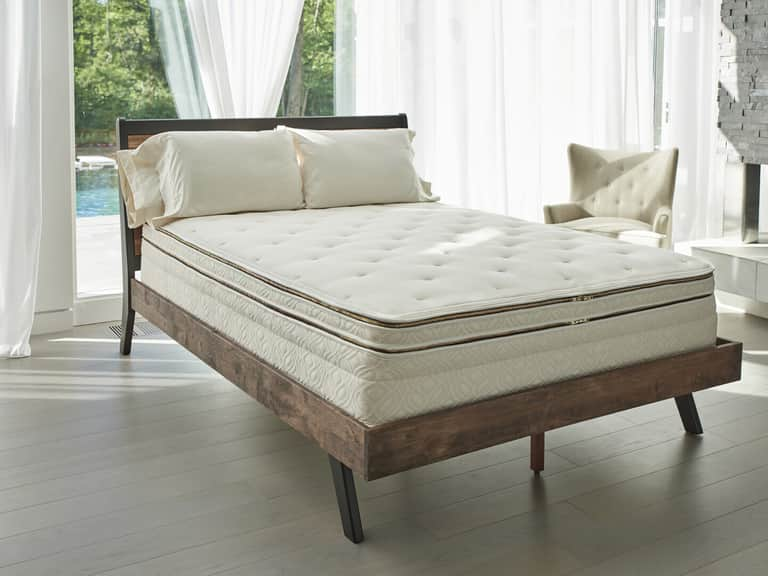
The Naturepedic Arcadia Hybrid Organic Mattress is one example of a product description that gives readers specific construction details: it lists organic wrapped coils, organic Dunlop latex, a wool blend layer, and firmness customization. Its published information also identifies GOTS and GOLS certifications. Those details provide a starting point for asking about the scope of each certification and how the individual configuration is assembled; they are not a substitute for checking fit, comfort, or documentation. Read the Arcadia mattress specifications.
Before comparing models, make a short list of questions. Is the latex certified, and which layer does that cover? Is the cover certification separate? What is the mattress’s full height? Can each side have a different firmness? What kind of foundation is required? What are the trial, return, and warranty terms? Clear answers make it easier to distinguish meaningful construction information from broad marketing language.
A comparison checklist
Keeping a compact record can prevent the small print from becoming a second mattress. For each option, note the following:
- Latex source and claim: Is the material described as natural, organic, or a blend, and is the description specific?
- Certification scope: Which organization issued the certification, and does it apply to the latex, textiles, or finished product?
- Core method: Is the latex Dunlop or Talalay, and does the manufacturer explain the layer’s role?
- Layer arrangement: Record materials, thicknesses, and firmnesses from top to bottom.
- Feel and fit: Consider sleeping position and pressure points, while treating general firmness advice as a starting point.
- Dimensions and base: Verify size, profile, sheet depth, and foundation requirements.
- Trial and care: Check return conditions, maintenance instructions, and warranty coverage.
It can help to keep “what is documented” separate from “what I expect to feel.” A certificate may document a material or process; it cannot tell you whether a particular firmness will feel comfortable to you. A showroom impression may reveal something about comfort; it does not verify the origin of the latex. Both kinds of information are useful, but they answer different questions.
Questions worth asking—and common misconceptions
Does GOLS certification mean the entire mattress is organic? Not necessarily. Certification has a defined scope. Check which component is certified and whether the cover and other layers have separate standards.
Does GOTS certify latex? GOTS is a textile standard, not the latex-specific credential shoppers may be looking for. It may be relevant to a cotton cover or other textile parts of a mattress.
Is Dunlop always firmer than Talalay? No. The type of latex is one factor among several. Formulation, firmness, layer thickness, and the surrounding construction all affect the feel.
Does “natural latex” mean “organic latex”? No. Natural describes the material’s source in general terms; organic status depends on applicable standards and documentation.
Will an organic latex mattress solve a sleep problem? No mattress label can promise that. A comfortable, supportive surface may be one part of a helpful sleep environment, but persistent or serious sleep difficulties are a matter to discuss with a qualified health professional.
The sensible conclusion
Choosing organic latex is less a matter of discovering a perfect label than of assembling a clear picture. A certification can establish something important, provided its scope is understood. Dunlop and Talalay describe different production routes, not automatic rankings. Firmness is an interaction between the mattress and the sleeper, and fit includes the room, frame, sheets, and support beneath the bed.
The most trustworthy comparison is therefore specific and modest. It says what the materials are, names the standards that apply, explains the layers, and leaves room for personal comfort to be personal. In the end, a mattress is both an object with a supply chain and a place where someone hopes to sleep. It deserves to be judged by both accounts.