Bedding · Sleep education
What to Know About Organic Crib Mattresses: Materials, Fit, and Care
A crib mattress is an unshowy object with an unusually important job. To compare organic options thoughtfully, look beyond the label: examine what the mattress is made of, what its certifications actually cover, how securely it fits the crib, and how the sleep surface can be kept clean without adding unnecessary layers.
Preparing a baby’s sleep space can turn ordinary nouns into research projects. Cotton acquires a supply chain; foam becomes a question of chemistry; a mattress cover seems to require its own glossary. The word organic may appear to promise a simpler answer, but it is not a complete description of a product. It does not, by itself, tell you how the mattress is built, whether every component is certified, or whether the mattress will fit the crib you already have.
A more useful approach is to treat the label as an invitation to inspect details. Identify the materials in the cover and core. Check which certification applies to which parts. Confirm the mattress dimensions against the crib manufacturer’s instructions. Then read the care guidance before adding a pad or protector. These steps are less dramatic than a promise of a perfect sleep, but they give families facts they can use.
This guide explains common organic crib mattress materials and construction terms, offers a practical way to assess fit, and considers how a breathable, washable cotton pad can support routine care. It is educational information, not a substitute for current safe-sleep guidance or advice from a pediatric clinician. For the sleep environment, follow the recommendations of appropriate public-health authorities and the instructions supplied with your crib and mattress.
What “organic” means—and what it does not
In bedding, “organic” generally refers to how particular agricultural materials are grown and processed, or to a standard that evaluates a defined portion of a finished textile product. It is not a single universal grade for an entire mattress. A mattress may have an organic cotton cover, for example, while its core consists of another material. The reverse can also be true: a product may use a particular core material but have a cover with a different composition.
That distinction matters because marketing language can compress several separate claims into one reassuring phrase. “Organic mattress” might refer to a certified textile, a set of named materials, or a manufacturer’s broader description. The exact meaning depends on the product’s construction and the standards behind the claim. Read the component list, certification details, and care label rather than relying on the headline alone.
When a certification is mentioned, ask what it certifies. Some programs focus on textile processing and the presence of organic fibers; others set limits or requirements related to chemicals, environmental practices, or social criteria. A certification may cover the fabric but not the mattress core, or it may apply to a particular component rather than every finished-product element. Look for a clearly identified standard and scope, not just a logo or the word “certified.”
For instance, GOTS is a textile standard whose scope and criteria should be checked against the product documentation. If a crib mattress or pad is described as GOTS certified, look for information identifying the certified item and its certification details. Avoid assuming that one certified fabric automatically makes every material in the whole product certified. Transparent descriptions are usually more helpful than broad claims.
Organic certification is also not the same thing as a guarantee of better sleep, allergy prevention, or medical benefit. Families may reasonably prefer certain materials or production practices, but the label does not replace the practical questions of fit, firmness, construction, and maintenance. Nor does the word “natural” necessarily mean organic or explain how a material was processed.
Read the mattress as a set of components
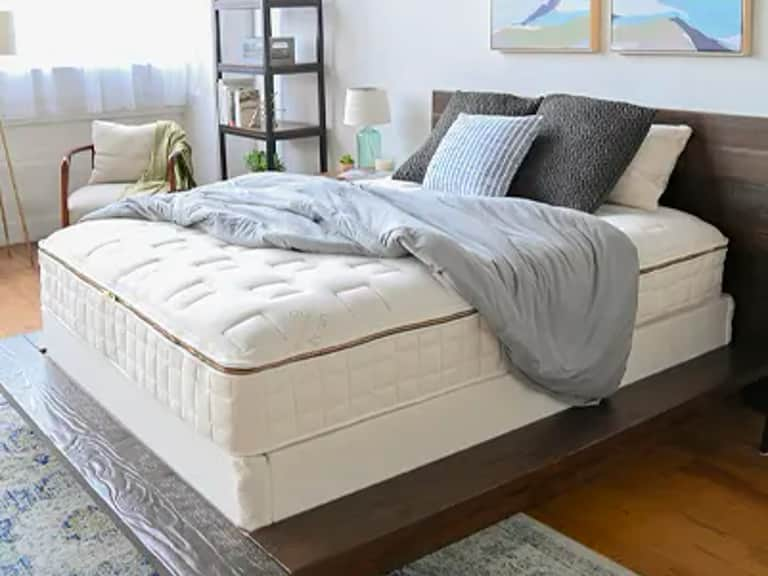
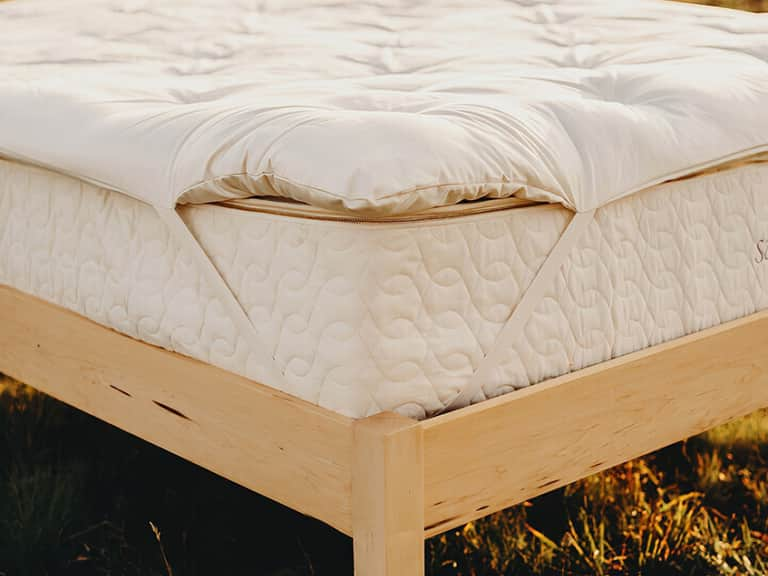
A crib mattress is easiest to understand when considered from the outside inward. The cover is the surface you see and touch. Beneath it, the core provides the mattress’s structure. Some models also include barriers, quilting, or other layers. Each component can use different materials, and each can have different cleaning instructions.
The cover
Organic cotton is common in bedding because it can be woven or knitted into a soft textile. On a mattress, the cover’s role is not simply to feel pleasant: it forms part of the finished surface and may be designed to resist wear or moisture. Ask whether the cover is removable, whether it can be washed, and whether the maker permits spot cleaning only. A cover that cannot be removed should not be treated as though it were ordinary washable bedding.
Look for the fiber content and any coatings or treatments described in the product information. If a waterproof layer is present, find out what material it uses and whether the manufacturer gives specific cleaning instructions. A surface that is water resistant, waterproof, or merely wipeable may require different care. These descriptions should not be treated as interchangeable.
The core
Mattress cores may be made from materials such as foam, latex, innerspring components, or combinations of layers. The term “organic” does not identify the core material, and the word “natural” does not explain its density, structure, or performance. Look for a plain-language description of what is inside and how the mattress is intended to be used.
For a crib, do not choose a surface based on an adult’s preference for a soft or plush feel. Follow current safe-sleep recommendations and the crib and mattress manufacturers’ instructions. The mattress should be designed for the specific crib type and used as directed. If details about firmness, construction, or intended use are unclear, ask the manufacturer for clarification before making a decision.
Layers, seams, and edges
Quilting, seams, and borders are part of the construction, not decorative footnotes. Inspect the product description for how the cover is attached and whether the mattress has a defined top and bottom. A mattress that can be used on either side should say so; if it has a designated infant side, follow the maker’s instructions about orientation and use. Do not infer that a mattress is reversible simply because both sides look similar.
Understand which components are intended to be removed, if any. Taking apart a mattress or replacing a layer in a way the manufacturer does not permit can alter its intended structure. Keep product instructions and any applicable care documentation accessible, especially if the mattress will be used by more than one caregiver.
How to interpret certifications and claims
Certifications can make complex supply-chain information more legible, but they are most useful when readers know what question they answer. A textile certification may address the fibers or processing of a fabric. A chemical-emissions program may assess a different part of a product. Neither automatically establishes that a mattress is the right size for a crib or that it is suitable for a particular use.
When comparing organic crib mattresses, note the exact name of each standard and the component it covers. Then check whether the seller or manufacturer provides a certificate number, a current certification record, or a clear explanation of scope. If the claim cannot be traced to a standard or supporting documentation, treat it as a claim to investigate rather than a conclusion.
- Identify the material. Is the claim about cotton, wool, latex, or the whole product?
- Identify the standard. Is a recognized certification named, with enough detail to verify its scope?
- Separate certification from performance. Organic status does not by itself establish firmness, durability, waterproofing, or ease of cleaning.
- Read the exclusions. A certificate may apply to fabric or processing while excluding other components.
- Be wary of absolutes. Phrases such as “chemical-free” are imprecise; all physical materials consist of chemicals. Specific, verifiable statements are more informative.
The same careful reading applies to claims about being hypoallergenic, non-toxic, or entirely free of emissions. Such phrases can mean different things in different contexts. A certification or test may provide useful information, but consumers should check what was evaluated, under which conditions, and whether the result applies to the finished mattress or only one element.
Fit: the detail that cannot be solved by a label
A mattress can use carefully specified materials and still be the wrong choice if it does not fit the crib. Before shopping, find the crib’s model information and consult the manufacturer’s stated mattress requirements. Measure only as a secondary check; the manufacturer’s guidance and the mattress maker’s compatibility information should be considered together.
Standard crib mattress dimensions are often described as approximately 28 by 52 inches, but “standard” should not be treated as a guarantee of compatibility. Products and cribs can vary, and listed dimensions may include a tolerance. Check both length and width, along with the mattress thickness and the crib’s permitted range. A mattress designed for a portable crib or mini crib is not interchangeable with one intended for a full-size crib.
After placing the mattress in the crib according to the manufacturers’ instructions, assess whether it lies flat and fits securely. It should not bow, bunch, or leave a substantial gap at the edges. Do not try to correct a poor fit by adding rolled towels, foam, extra padding, or improvised fillers. If there is uncertainty about fit, stop using the setup until you have confirmed compatibility with the crib and mattress manufacturers.
Fit can change with accessories. A pad or protector adds a layer over the mattress and must be designed for the crib mattress’s dimensions and depth. It should stay flat and secure, without loose corners or excess fabric. Avoid stacking layers in a way that changes the intended sleep surface or conflicts with safe-sleep instructions. A fitted sheet, if used, should also be the correct size and fit snugly, following the crib and mattress guidance.
It helps to make a short checklist before purchase: crib model; mattress length and width; allowable thickness; intended crib type; pad or protector dimensions; and whether each product’s manufacturer identifies it as compatible. This small inventory can prevent a familiar domestic inconvenience—the arrival of an object that is beautifully described and practically wrong.
A washable mattress pad: useful, but not a substitute for fit
A mattress pad can protect the mattress surface and make routine laundering more manageable. It should not be thought of as a replacement for a correctly fitting mattress, and it should not introduce a loose or overly cushioned layer. Confirm that a pad is intended for crib use, fits the specific mattress, and can be secured in the way its instructions describe.
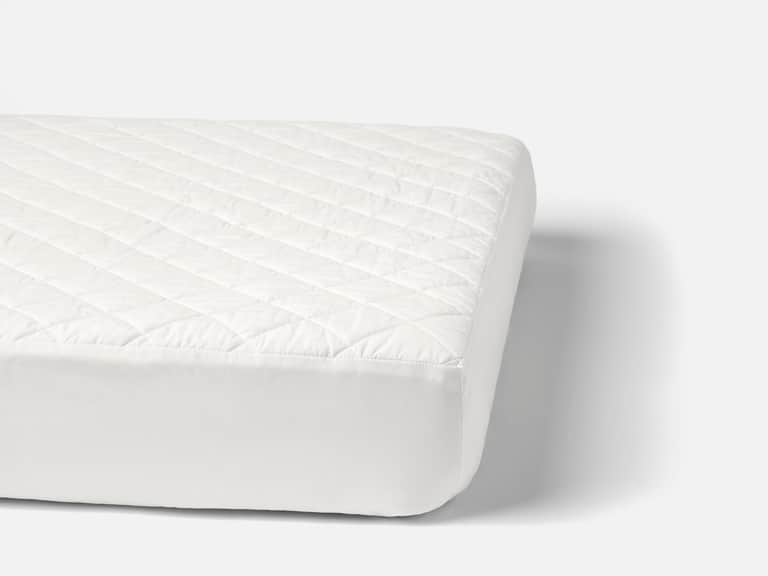
One example is the Organic Crib Mattress Pad, described as made from 100 percent organic cotton, inside and out, with a quilted construction and a percale cover. Its product information identifies GOTS certification and gives care instructions: machine wash cold on a gentle cycle and tumble dry on low. It is described as sized for a standard crib mattress. Those details are useful starting points, not a reason to skip checking the actual mattress dimensions and the pad’s fit.
Before using any pad, read its complete instructions and inspect it after fitting. It should lie smooth, without folds, bunching, or loose edges. If it cannot be secured properly, do not try to make it fit with pins, clips, or other improvised fasteners. The mattress maker’s guidance and applicable safe-sleep recommendations take precedence over convenience.
Breathability is a property often mentioned in discussions of cotton, but a fabric description alone does not establish that an entire sleep setup is safe or suitable. The assembled surface includes the mattress, pad, and sheet, if used. Follow the instructions for each item and avoid adding accessories that are not recommended for the crib or the child’s sleep environment.
Care that preserves the materials
Care instructions can seem like an afterthought until a spill occurs at an inconvenient hour. Read them before the mattress is in use. A removable cover may have different instructions from the core; a pad may be machine washable while the mattress itself is spot-clean only. Applying one product’s washing directions to another can cause shrinkage, damage, or a loss of intended fit.
For washable cotton bedding, the label may specify a cool or cold cycle, gentle agitation, and low-temperature drying. Follow the exact instructions provided rather than assuming that hotter water or a longer cycle will provide better care. High heat can affect fibers, elastic, coatings, and dimensions. If the product calls for line drying or a particular detergent, respect that direction.
For a mattress that is not machine washable, follow the maker’s approved spot-cleaning method. Avoid soaking the core, using unapproved solvents, or applying strong fragrances to disguise an odor. Let cleaned areas dry completely before replacing bedding. If moisture reaches internal layers, or if the mattress shows signs of damage, consult the manufacturer about whether it remains suitable for use.
Keep the sleep surface free of unnecessary products and check it periodically. Look for damaged seams, torn covers, compromised waterproof layers, persistent odors, or signs that the mattress no longer lies flat. A care routine need not be elaborate: prompt attention to spills, laundering compatible bedding as directed, and a periodic inspection are often more practical than an aggressive cleaning schedule.
Do not use bleach or other harsh treatments unless the product instructions explicitly allow them. A fabric’s organic status does not mean it can tolerate every cleaner, and an odor-free result is not a reliable measure of cleanliness. When in doubt, ask the manufacturer for a written care recommendation tied to the specific model.
Common questions about organic crib mattresses
Does an organic label mean every part of the mattress is organic?
No. The label may refer to a particular material or certified component. Review the full materials list and certification scope to understand which parts are covered. If the product description is unclear, ask the manufacturer rather than assuming the claim applies to every layer.
Is a cotton cover enough to establish that a mattress is organic?
No. Cotton is a fiber, while organic status depends on how the fiber was grown and processed and whether the relevant claim is supported by certification or other documentation. A cotton cover also says nothing by itself about the mattress core.
Can a mattress pad make a mattress fit better?
No. A pad is a bedding layer, not a way to correct a mismatch between the crib and mattress. Choose a mattress that meets the crib manufacturer’s requirements. Use a pad only if it is designed for the mattress and can be fitted securely according to its instructions.
Can the mattress cover be washed?
That depends on the model. Some covers are removable; others are not, and some are intended only for spot cleaning. Follow the mattress maker’s care instructions and do not remove a cover unless the manufacturer says it is designed to come off.
Do organic materials prevent allergies or guarantee better sleep?
No material label can guarantee an individual health outcome or a particular sleep result. Families may have personal preferences about fibers and processing, but claims about allergies or health should be evaluated carefully and discussed with a qualified clinician when they involve a medical concern.
A measured way to make a choice
Comparing organic crib mattresses does not require mastering every technical term. Start with the crib’s specifications and intended mattress size. Then read the mattress materials from cover to core, distinguishing fiber content from broader claims. Check certifications by name and scope, and make sure the manufacturer explains how to clean and maintain the product.
Next, consider any pad or protector as part of the complete setup. Confirm that it is intended for crib use, matches the mattress dimensions, and can be secured smoothly. Review care instructions for both the mattress and its accessories, since their materials may have different needs. Keep the product documentation so that other caregivers can follow the same guidance.
Organic materials can be a meaningful preference, and transparent sourcing can help families make choices that reflect their priorities. But the most useful product description is one that answers ordinary, consequential questions: What is it made of? What does the certification cover? Will it fit this crib? How should it be cleaned? The answers are less poetic than the word “organic,” yet they are what make a mattress understandable—and a sleep space easier to care for.
When product instructions conflict, fit is uncertain, or a safety question remains, contact the crib or mattress manufacturer and consult current guidance from a trusted public-health source. In a room full of advice, the clearest decision often begins with the specifications in front of you.